Training Camp Day 6: Alex Sarr a full participant in Monday’s practice

WASHINGTON, DC - MARCH 19: Alex Sarr #20 of the Washington Wizards handles the ball against the Detroit Pistons at Capital One Arena on March 19, 2026 in Washington, DC. NOTE TO USER: User expressly acknowledges and agrees that, by downloading and or using this photograph, User is consenting to the terms and conditions of the Getty Images License Agreement. (Photo by G Fiume/Getty Images) | Getty Images

WASHINGTON — Nearly four months removed from surgery to repair his fractured right foot, Alex Sarr said he was a full participant at Monday’s practice.

Sarr had been a partial participant through the first five days of training camp but has now progressed to 5-on-5 work and live drills.

“I was a full go today, [did] most of the drills at the position. Felt good,” Sarr said. “It’s been a long process … After being on the sidelines for months, you’re just excited to get back out there and compete with the guys.”

Brian Keefe later added that Sarr is still “in the ramp-up phase” of his recovery, so it appears the young center has a few more checkpoints before his full return.

Videos of these interviews with Sarr, Keefe and Tre Mann are available on wizardscentral.com.

Washington’s No. 2 pick in the 2024 draft endured a rough start to his career. His 0-15 shooting performance in his Summer League debut made headlines, as did his sub-40% shooting season as a rookie.

He shed those struggles during a breakout sophomore campaign that included meaningful improvements in his shot diet, shooting efficiency and defensive production.
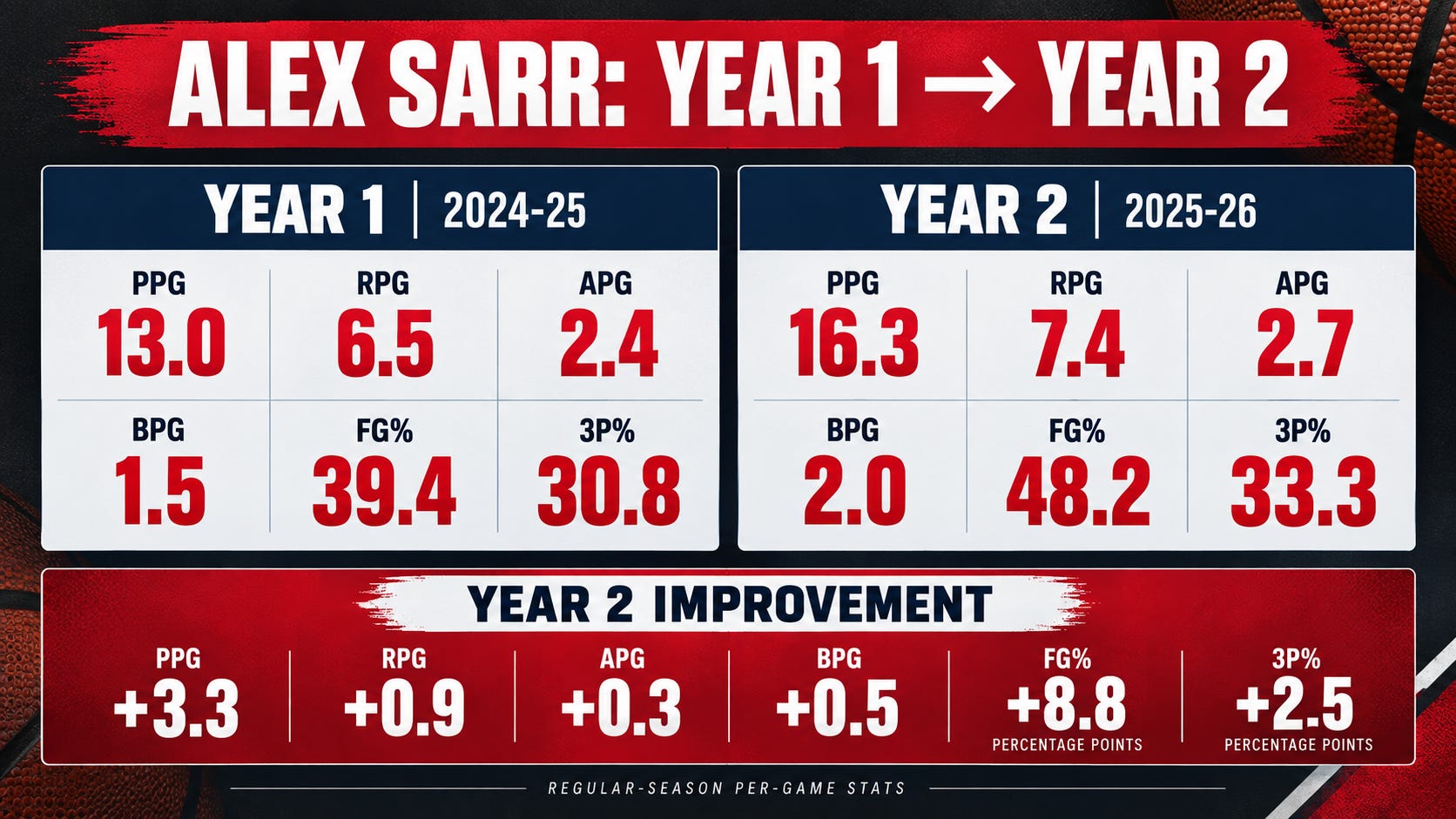
The Wizards’ defense ranked 28th and 30th, respectively, during Sarr’s first two seasons, which was no fault of his own. Sarr’s 2.0 blocks per game trailed only Victor Wembanyama last season. His 9.7 rim attempts defended per game ranked first. And amid that volume of contests, he held opponents to an -8.8 FG% vs. expected, according to Basketball University.

Sarr needed help. So Will Dawkins traded for Anthony Davis, a five-time All-Defense selection who’s known as one of the league’s best shotblockers.

After two seasons of Sarr’s defense or nothing around the basket, Washington has built one of the league’s most formidable rim-protecting duos. And Sarr couldn’t be happier.

“I’m very excited. Once you get past me, you’ve got AD on the back, and the other way around, it’s the same,” Sarr said. “AD will allow me to be more aggressive in pursuing blocks, knowing I have someone to rebound the ball or box out the big behind me.”

Keefe talks Thursday’s preseason opener

As expected, Keefe didn’t budge when I asked him whether Sarr would play in Thursday’s preseason opener against the New York Knicks.

He did, however, confirm that Tristan Vukcevic (hip) and Jamir Watkins (ACL) wouldn’t play, which were not surprising developments. And he praised Sarr’s recovery as the 7-footer eyes an opening-night return.

“It was good to see [Alex] out there,” Keefe said. “He’s been diligent about his work this offseason with his rehab. And we were happy to see him out there.”

Watkins, who underwent surgery to repair a torn ACL in July, shot free throws and joked around with his teammates during the media-viewing portion of Monday’s practice. The stout defender is unlikely to play this season, but it was an encouraging sign to see him participating in some fashion at practice this early in his rehab process.

Preseason serves as an early evaluator for coach’s to understand what works, and what doesn’t, before meaningful games begin. Keefe said preseason evaluation is focused on the team, not individual player performances, as Thursday’s opener nears.

“It’s about the team first, trying to evaluate if we’re following the principles and the things we worked on during camp,” Keefe said. “We don’t expect to be perfect, but we want to make strides each day. There’s always great lessons to learn from a game.”

Mann talks buying into his role

Tre Mann joined the Wizards in August following a trade that reunited him with Will Dawkins, who worked in the Oklahoma City Thunder’s front office when they selected Mann with the No. 18 pick in the 2021 draft.

Mann has learned a lot through his first five NBA seasons. Namely, how to buy into his role — how to be more than just a scorer.

“My whole life, I’ve been a scorer,” Mann said. “And I feel like, in OKC and Charlotte, when I wasn’t scoring, my mindset wasn’t to flip it on to defense or switch it to something else. It’s been, ‘How can I start scoring better.’ Now, I’ve realized that I’m more of a complete basketball player. If I’m not scoring, I’m gonna get guys involved, I can defend.”

So, after discovering there’s more to earning rotational minutes than pure scoring, what does Mann see as his role in a crowded Washington backcourt? The answer is simple: Whatever Keefe needs him to do.

“Whatever they need. Just a leader, a veteran presence,” Mann said. “Whether I’m playing or not, just being in guys ears, trying to help us win. If they want me to distribute, if they want me to score [or defend] — just whatever they ask me to do.”

Bonus Notes

Sarr participated in practice during the media-viewing portion for the first time during Wizards training camp:

AJ Dybantsa and Bub Carrington got shots up during Monday’s practice.

For more coverage like this, subscribe to wizardscentral.com.

ALDS Game Two Preview: Must win for the Yankees

Oct 10, 2010; Arlington, TX, USA; Tampa Bay Rays first baseman Carlos Pena (1) in the on-deck circle in the eighth inning of game four of the 2010 ALDS against the Texas Rangers at Rangers Ballpark. The Rays beat the Rangers 5-2. Mandatory Credit: Matthew Emmons-USA TODAY Sports | IMAGN IMAGES via Reuters Connect

The Tampa Bay Rays and New York Yankees are back at it tonight for the second game of the American League Division Series.

The two teams met up on Saturday for an epic pitcher’s duel. The Rays won thanks to a masterful performance from Drew Rasmussen, who came just four outs shy of throwing the 3rd no-hitter in MLB postseason history. Jonathan Aranda provided the lone run of the game as he launched a solo homerun off of Gerrit Cole. Meanwhile, the only hit the Yankees knocked on the night was off the bat of Austin Wells but thanks to a questionable baserunning decision and excellent Rays defense was thrown at third base to end the 8th inning. The ever dependable Bryan Baker set down the Yankees in order for a flawless 9th inning save to close out the Rays 1-0 victory.

Tonight, there could be another pitcher’s duel as the Yankee will send Cy Young favorite Cam Schlittler to the mound in hopes of evening up the series while the Rays will send out the AL Pitcher of the Month, Freddy Peralta, to try and notch another win closer to the ALCS.

It will be an extremely tough task for the Rays to mount any offense against Schlittler. Since making his Major League debut last July, the 25-year old right-handed pitcher has been the American League’s best pitcher. He finished the 2026 regular season with a 1.95 ERA | 2.56 FIP with a 31.4 K% and 6.4 BB% over 193.2 IP averaging roughly 6 IP per start. Since making his big league debut, Schlittler has accrued 7.5 fWAR which is 3rd among all pitchers while his 2.23 ERA is the lowest among all starters with at least 130 IP.

There isn’t a splits advantage to be found against Schlittler, who was equally dominant against both sides of the plate in 2026 with lefties faring slightly better but still only producing a .560 OPS (RHB had a .520 OPS). Lefties also struck significantly more (34.7%) compared to RHB (26.4%). Schlittler is nearly unhittable the first two times through the order but does wear down during the third trip through. It will be interesting to see how Aaroo Boone manages this if the two sides remain in a close late in the game.

For the Rays, Freddy Peralta has been excellent and everything they could have hoped for after acquiring him from the New York Mets at the trade deadline. The ace of the Brewers staff for several years, Milwaukee traded Peralta to the Mets this past offseason following a Cy Young caliber campaign. However, Peralta struggled mightily with the team from Queens during his brief tenure there in 2025 as he seemingly was unable to tap into all of the things that made him an ace in Milwaukee. That changed once the Rays acquired him at the trade deadline.

There were some growing pains over his first few outings, but the work was in motion and soon Peralta had rediscovered his fastball and developed a change-up to pair with it. This combined with an exceptional defense had led to a resurgence. Since the start of play on August 26th, Peralta has a 0.79 ERA | 2.78 FIP over 34 IP. That is the lowest mark in baseball over that time with his mound opponent, Cam Schlittler ranking 2nd with a 1.01 ERA.

The Rays offense was mostly quiet during game one as Gerrit Cole and the Yankees bullpen kept the lineup in check. They pitched around Junior Caminero and there were just a few opportunities to score on three walks and five hits.

The ceremonial first pitch tonight will be thrown by former Rays first baseman, Carlos Pena. The slugging first baseman still holds the single-season franchise record for most homeruns in a season and was an integral part of the team’s turnaround in 2008. After a year away in 2011, he returned in 2012 to one of the largest ovations in Tropicana Field history and promptly hit a grand slam in one of those magical baseball moments.

First pitch is slated for 8pm tonight on TBS.

Capitals' Alex Ovechkin has chance for more records in final NHL season

Washington Capitals winger Alex Ovechkin sits at an NHL-record 929 goals after announcing that he will retire from the NHL after the 2026-27 season.

The 41-year-old has 82 games left this season to add to that total, starting on Wednesday, Oct. 7 at home against the rival Pittsburgh Penguins and fellow superstar Sidney Crosby.

Ovechkin broke the seemingly unbreakable Wayne Gretzky record of 894 goals during the 2024-25 season. The following season, he became the first NHL player to score 900 goals.

He has a chance to break or tie other records this season and reach other milestones. Here's a look, plus records that he currently holds:

Records Alex Ovechkin's still chasing

  • 20-goal seasons: He's at 21 seasons, one behind Gordie Howe.
  • Combined regular-season/playoff goals: He's at 1,006, 10 behind Gretzky.
  • Even-strength goals: He's at 593, 24 behind Gretzky.

Ovechkin also needs four more assists to break Nicklas Backstrom's team career record of 762 assists.

Alex Ovechkin records

  • Total goals: 929
  • Power play: 331
  • Empty net: 72
  • Game winners: 141
  • Overtime goals: 27
  • Goalies scored on: 189
  • 30-goal seasons: 20
  • 40-goal seasons: 14
  • 50-goal seasons: 9, tied for first

Alex Ovechkin's upcoming milestones

  • 12 points shy of 1,700 career points
  • 25 games from 1,600 career games
  • 36 points from passing Mario Lemieux for the ninth-most points in NHL history
  • 33 games shy of passing Patrick Marleau (1,607) for the second-most games played with one franchise

This article originally appeared on USA TODAY: Capitals' Alex Ovechkin has chance for more records in final NHL season

Capitals' Alex Ovechkin has chance for more records in final NHL season

Washington Capitals winger Alex Ovechkin sits at an NHL-record 929 goals after announcing that he will retire from the NHL after the 2026-27 season.

The 41-year-old has 82 games left this season to add to that total, starting on Wednesday, Oct. 7 at home against the rival Pittsburgh Penguins and fellow superstar Sidney Crosby.

Ovechkin broke the seemingly unbreakable Wayne Gretzky record of 894 goals during the 2024-25 season. The following season, he became the first NHL player to score 900 goals.

He has a chance to break or tie other records this season and reach other milestones. Here's a look, plus records that he currently holds:

Records Alex Ovechkin's still chasing

  • 20-goal seasons: He's at 21 seasons, one behind Gordie Howe.
  • Combined regular-season/playoff goals: He's at 1,006, 10 behind Gretzky.
  • Even-strength goals: He's at 593, 24 behind Gretzky.

Ovechkin also needs four more assists to break Nicklas Backstrom's team career record of 762 assists.

Alex Ovechkin records

  • Total goals: 929
  • Power play: 331
  • Empty net: 72
  • Game winners: 141
  • Overtime goals: 27
  • Goalies scored on: 189
  • 30-goal seasons: 20
  • 40-goal seasons: 14
  • 50-goal seasons: 9, tied for first

Alex Ovechkin's upcoming milestones

  • 12 points shy of 1,700 career points
  • 25 games from 1,600 career games
  • 36 points from passing Mario Lemieux for the ninth-most points in NHL history
  • 33 games shy of passing Patrick Marleau (1,607) for the second-most games played with one franchise

This article originally appeared on USA TODAY: Capitals' Alex Ovechkin has chance for more records in final NHL season

Capitals' Alex Ovechkin has chance for more records in final NHL season

Washington Capitals winger Alex Ovechkin sits at an NHL-record 929 goals after announcing that he will retire from the NHL after the 2026-27 season.

The 41-year-old has 82 games left this season to add to that total, starting on Wednesday, Oct. 7 at home against the rival Pittsburgh Penguins and fellow superstar Sidney Crosby.

Ovechkin broke the seemingly unbreakable Wayne Gretzky record of 894 goals during the 2024-25 season. The following season, he became the first NHL player to score 900 goals.

He has a chance to break or tie other records this season and reach other milestones. Here's a look, plus records that he currently holds:

Records Alex Ovechkin's still chasing

  • 20-goal seasons: He's at 21 seasons, one behind Gordie Howe.
  • Combined regular-season/playoff goals: He's at 1,006, 10 behind Gretzky.
  • Even-strength goals: He's at 593, 24 behind Gretzky.

Ovechkin also needs four more assists to break Nicklas Backstrom's team career record of 762 assists.

Alex Ovechkin records

  • Total goals: 929
  • Power play: 331
  • Empty net: 72
  • Game winners: 141
  • Overtime goals: 27
  • Goalies scored on: 189
  • 30-goal seasons: 20
  • 40-goal seasons: 14
  • 50-goal seasons: 9, tied for first

Alex Ovechkin's upcoming milestones

  • 12 points shy of 1,700 career points
  • 25 games from 1,600 career games
  • 36 points from passing Mario Lemieux for the ninth-most points in NHL history
  • 33 games shy of passing Patrick Marleau (1,607) for the second-most games played with one franchise

This article originally appeared on USA TODAY: Capitals' Alex Ovechkin has chance for more records in final NHL season

As Alex Ovechkin announces final season, Las Vegas holds a lasting place in his legacy

LAS VEGAS — Before Alex Ovechkin became the greatest goal scorer in NHL history, he became a Stanley Cup champion on the ice at T-Mobile Arena.

For Las Vegas, that distinction carries two memories: the heartbreak of watching the Golden Knights’ remarkable inaugural season end, and the sight of one of hockey’s greatest players finally lifting the trophy that had eluded him.

Now, with Ovechkin announcing Monday that the 2026-27 season will be his last in the NHL, this city occupies a meaningful place in the farewell.

Washington is where he built his career. Las Vegas is where some of its most memorable chapters unfolded.

“My family and I decided this summer that this will be my final year in the NHL,” Ovechkin said in a statement released by the Capitals. “I love this game so much, but I know in my heart it’s the right decision.”

The announcement came exactly 21 years after his NHL debut. At 41, the Capitals captain has 929 goals and 1,688 points in 1,575 games, with one final season to add to those totals.

The night two histories met

On June 7, 2018, Las Vegas hosted the conclusion of two extraordinary hockey stories.

The Golden Knights had turned an expansion season into a run to the Stanley Cup Final. Ovechkin had spent 13 seasons pursuing the championship that would complete his résumé.

Washington’s 4-3 victory in Game 5 brought both journeys to their defining moment.

Ovechkin scored a second-period power-play goal, his 15th of the postseason. Vegas carried a 3-2 lead into the third before Devante Smith-Pelly tied it and Lars Eller supplied the championship-winning goal. Ovechkin received the Conn Smythe Trophy as playoff MVP and raised the Stanley Cup in the Golden Knights’ building.

For a city still discovering what NHL hockey could mean, the scene offered an unforgettable lesson in the sport’s emotional extremes. One team’s crushing ending unfolded alongside another’s long-awaited breakthrough.

That image belongs to Washington’s history, but its setting will always belong to Las Vegas.

There was another connection: George McPhee, the executive who drafted Ovechkin first overall for Washington in 2004, was Vegas’ general manager when the Capitals won that championship.

Three goals closer to immortality

More than six years later, Ovechkin returned to T-Mobile Arena and delivered another performance that became part of his legacy.

On Nov. 17, 2024, he scored three times in Washington’s 5-2 victory over the Golden Knights.

Career goals Nos. 864, 865 and 866 made up his 31st NHL hat trick and left him 29 goals from surpassing Wayne Gretzky’s record of 894.

A power-play goal, a goal off the rush and an empty-net finish illustrated the different ways Ovechkin could punish an opponent. At 39, he was still producing nights that accelerated a chase once considered nearly impossible.

"It’s gonna stay forever," Ovechkin told The Hockey News that night. "Memories that happen here, (like) back in (2018) - it’s great.

"It was (a) pretty cool atmosphere, like always."

The Golden Knights also figured in another milestone that season. On Oct. 15, 2024, Ovechkin recorded two assists against Vegas in Washington to reach 700 for his career.

Ovechkin ultimately surpassed Gretzky on April 6, 2025, against the New York Islanders. The record fell elsewhere. Las Vegas had witnessed a memorable surge toward it.

One more visit, one lasting connection

Washington is scheduled to visit T-Mobile Arena on Jan. 30, 2027, giving Las Vegas a chance to acknowledge Ovechkin during his final NHL season.

There is still history available to him. He is 11 goals from passing Gretzky for the most combined regular-season and playoff goals, and 12 points from reaching 1,700.

His farewell will also include a season-long charitable campaign, with monthly initiatives beginning in November supporting causes central to his career.

Addressing his teammates in the locker room, Ovechkin kept his closing message focused on the season ahead.

"Let’s enjoy it and let’s do some special thing this year," he said.

Las Vegas has been part of that career in ways few visiting cities can claim.

It watched him become a champion. It watched him score three times while pursuing immortality.

When he returns, the city will have another opportunity to recognize a player whose greatest celebration remains forever tied to its ice.

PHOTO CAPTION

Washington Capitals left wing Alex Ovechkin (8) hoists the Stanley Cup after defeating the Vegas Golden Knights in game five of the 2018 Stanley Cup Final at T-Mobile Arena.

Next game at Dodger Stadium is up in the air

LOS ANGELES, CALIFORNIA - OCTOBER 04: A general view before the game between the Los Angeles Dodgers and the Atlanta Braves in game two of the National League Division Series at Dodger Stadium on October 04, 2026 in Los Angeles, California. (Photo by Ryan Sirius Sun/Getty Images) | Getty Images

LOS ANGELES — By losing Game 2 of the National League Division Series on Sunday night, the Dodgers and Braves are now tied at one game apiece in the series, and home-field advantage wrests with Atlanta with the next two games at Truist Park. The Dodgers need to win at least once in Atlanta to ensure they will play again at Dodger Stadium this season.

Let’s take a look at the possibilities for the next time the Dodgers will play at Chavez Ravine.

Friday, October 9, NLDS Game 5 vs. Braves

This seems like the most likely scenario. If the Dodgers and Braves split the two games in Atlanta, the Division Series will be decided on Friday, October 9 in Los Angeles with a winner-take-all Game 5.

Sunday, October 11, NLCS Game 1 vs. Padres

This is the least likely of the scenarios, mostly because too many things need to happen for this to come true. First, the Dodgers would need to win the NLDS over the Braves before coming home, by beating them twice in Atlanta. And it would require the Padres to overcome their 2-0 hole to the Brewers in the other NLDS, winning the next three games.

Wednesday, October 14, NLCS Game 3 vs. Brewers

The Brewers have three chances to win the one game they need to advance to a second straight NLCS, and with the best record in baseball at 103-59, the Brewers would start any series at home in Milwaukee. This scenario would also require the Dodgers to win two in a row in Atlanta, avoiding the home Game 5 of the NLDS.

Thursday, March 26, 2027 vs. Braves (or later?)

If the Dodgers lose the next two games in Atlanta, their 2026 season is over, and it’ll be time to look ahead to 2027. Opening day is scheduled for next March 26 at Dodger Stadium, but there will be a lockout once the collective bargaining agreement expires on December 1, followed by a long battle between the owners and players over a new CBA. Whether next season starts on time is yet another variable to consider.

Ranking the Rockies, 2026: No. 50, Troy Johnston

WASHINGTON, DC - AUGUST 26: Colorado Rockies right fielder Troy Johnston (20) celebrates his home run with second baseman Connor Norby (35) during the game between the Colorado Rockies and the Washington Nationals on August 26, 2026 at Nationals Park in Washington, D.C. (Photo by Mark Goldman/Icon Sportswire via Getty Images) | Icon Sportswire via Getty Images

Welcome to the 2026 edition of Ranking the Rockies, where we take a look back at every player to log playing time for the Rockies in 2026. The purpose of this list is to provide a snapshot of the player in context. The “Ranking” is an organizing principle that’s drawn from Baseball Reference’s WAR (rWAR). It’s not something the staff debated. We’ll begin with the player with the lowest rWAR and end up with the player with the highest.


No. 50, Troy Johnston (-0.8 rWAR)

Troy Johnston wasn’t guaranteed anything when he arrived in Scottsdale last spring.

The Rockies had claimed him off waivers from Miami in November, during that strange period between Bill Schmidt stepping down and Paul DePodesta taking over baseball operations. He joined a crowded collection of first basemen and corner outfielders, and even making the Opening Day roster was hardly assured.

He made it.

Then he never left.

For the first time in his career, Johnston spent an entire season in the major leagues. He appeared in 128 games, received 449 plate appearances and, for long stretches, became one of the more reliable bats in a Rockies lineup that badly needed them.

Johnston spent months hitting around .300, piled up 32 doubles and showed an ability to square up major-league pitching. He also hit just four home runs, struggled in the field and on the bases, and gradually moved from an everyday role into something much more selective.

By the end of the year, the Rockies had a much clearer idea of what Johnston could do. The harder question was how much value that package ultimately carried.

The numbers

GPAABHR2B3BHRRBIBBSOSBAVG/OBP/SLGOPS
1284493971104132145037834.277/.348/.393.741

Johnston finished with a 95 OPS+, putting his full-season production just below league average. That still does a poor job of describing how he actually got there.

There were extended periods when he was quite a bit better than that. He hit .313/.371/.448 in March and April, .307/.365/.398 in May and .319/.402/.464 in June. Then came a disastrous July, followed by a .319/.407/.511 August and another sharp downturn in September.

Johnston did not spend six months looking like a 95 OPS+ hitter. He spent parts of the season looking like a legitimately good one and other parts looking like a player whose grip on regular playing time was disappearing.

What actually happened

Johnston wasted very little time making himself difficult to remove from the lineup.

On April 6 against Houston, batting cleanup and starting in right field, he went 3-for-5 with a double, a home run and two RBI in a 9-7 Rockies win. Less than two weeks later, he put together what may have been his best all-around offensive game of the season.

On April 18 against the Dodgers, Johnston went 3-for-4 with two doubles and two RBI as Colorado won 4-3. It was exactly the kind of night that would become familiar during his first few months: plenty of contact, balls into the gaps and production without needing to hit the ball over the fence.

Johnston made most of his defensive time in the outfield, primarily in right field, while also seeing action at first base.

Johnston showed some value on the other side of the ball the next afternoon, making a diving catch in right field for the final out of a 9-6 win over the Dodgers.

The Rockies responded by treating him like a regular. Through the end of June, Johnston had started 68 of the 77 games in which he appeared. His place in the batting order reflected it, too. There were experiments near the top early in the season, but by May and June he was regularly hitting fifth, right in the middle of the lineup.

He kept giving the Rockies reasons to put him there.

On June 14 against the Athletics, Johnston doubled, homered and drove in four runs in a 23-9 win. It was his biggest RBI game of the year and one of those occasional reminders that, while power was never going to define his game, he could still do damage when he got the right pitch.

By the end of June, Johnston was hitting .312/.378/.435 through 284 plate appearances. A player who entered camp unsure of a roster spot had become a regular in the lineup.

Then July changed the conversation.

Johnston hit .148/.234/.185 in 64 plate appearances. He still started 16 games during the month, but his place in the lineup was changing. After spending much of May and June batting fifth, Johnston made most of his July starts in the sixth or seventh spots.

August complicated the picture again.

Johnston was no longer playing every day, but he started hitting again. He batted .319/.407/.511 with a .918 OPS in 54 plate appearances while making only 12 starts. Five of those starts came from the No. 8 spot, and another five of his appearances came off the bench.

On Aug. 22, Johnston had two hits and a double. The next day, he came off the bench and doubled again. On Aug. 26 in Washington, hitting eighth as the designated hitter, he went 2-for-5 and launched his fourth home run of the season, a two-run shot in a 13-1 win.

The regular middle-of-the-order role was gone, but Johnston showed he could still produce when the plate appearances became less predictable.

The next day in Washington offered a reminder of the other parts of his game. Johnston was on first with two outs in the seventh inning when catcher Keibert Ruiz caught him straying too far from the bag and picked him off to end the inning.

By September, the smaller role had largely stuck. Johnston appeared in 14 games and started 11, receiving 47 plate appearances. Seven of those starts came from the seventh spot in the lineup.

On Sept. 6 against St. Louis, the Rockies briefly moved him all the way up to second. He went 0-for-5 with four strikeouts.

Nine days later, Johnston provided one last reminder of why the bat had kept him around all season. Against San Diego on Sept. 15, he went 3-for-3 with two doubles and two RBI in a 9-3 win.

He followed that with a handful of scattered hits down the stretch but finished September at .186/.255/.279, another sharp downturn after the August rebound.

The contact was real, but so were the limitations

Johnston’s July collapse looked dramatic in the box score, but he had not suddenly stopped hitting the ball hard.

In fact, his hard-contact rate increased to 46.7% during the month. The problem was where those balls were going.

MonthAVG.LD%GB%Hard%
April.31329.7%40.6%26.9%
May.30730.9%39.7%30.9%
June.31926.6%35.9%46.9%
July.14811.1%51.1%46.7%
August.31927.8%38.9%32.4%
September.18628.6%42.9%32.1%

When we looked at Johnston near the end of July, the issue was less about finding additional raw power than getting back to the line drives and gap contact that had made him productive earlier in the season.

The line drives returned in August, and so did the results.

That fits the larger offensive profile. Johnston’s .276 expected batting average was among the best in baseball, while his 39.7% launch-angle sweet-spot rate and 86% zone-contact rate reflected how consistently he put the ball in play at useful angles.

But useful contact and damage are different things. Johnston’s barrel rate was just 2.2%, his expected slugging percentage was .375 and he chased more than 35% of pitches outside the zone.

He was good at making contact when he swung. He just did not create much margin for error around that skill.

The platoon split points toward a more selective role. Johnston hit .299/.380/.418 with a .798 OPS in 337 plate appearances against right-handed pitching, compared with .214/.252/.320 and a .573 OPS against lefties.

The rest of his game pulled the overall value in the other direction.

Johnston stole four bases and was caught five times, with Baseball-Reference grading him two runs below average on the bases. Defensively, Baseball-Reference credited him with -9 Defensive Runs Saved overall and -9 fielding runs, while Statcast also graded his range below average.

Baseball-Reference graded Johnston at just four runs below average with the bat. The larger losses came on the bases, in the field and through the positional adjustment, leaving him at -0.8 rWAR.

There was, however, one place Johnston did not allow a run all year: the pitcher’s mound.

He made two appearances, worked two scoreless innings and allowed one hit. Baseball-Reference even credited him with 0.1 pitching WAR.

Johnston also brought plenty of energy and personality to a team that spent most of the season losing. It won’t determine a roster decision, but if Baseball Savant ever creates a personality percentile, Johnston would have a pretty strong case for the red.

Where does Johnston stand heading into 2027?

Last spring, the question was whether Troy Johnston could make the Rockies.

A year later, he is in almost the same place.

Colorado now has a full season of evidence showing what Johnston can provide, particularly against right-handed pitching. It also has a much clearer view of the limits around that skill set.

That still leaves Johnston looking like a possible left-handed matchup bat in a flexible role. His remaining options help, but younger players will be competing for those opportunities.

He made the team last March without any guarantees.

Heading into 2027, there is no guarantee he even gets the chance to do it again.


Join the conversation!

Sign up for a user account and get:

  • Fewer ads
  • Create community posts
  • Comment on articles, community posts
  • Rec comments, community posts
  • New, improved notifications system!

Download the SB Nation app on iOS or Android. 

Please keep in mind our Purple Row Community Guidelines when you’re commenting. Thanks! 

Keibert Ruiz saved his Washington Nationals career in 2026

LOS ANGELES, CA - SEPTEMBER 05: Keibert Ruiz #20 of the Washington Nationals runs the bases during the game between the Washington Nationals and the Los Angeles Dodgers at UNIQLO Field at Dodger Stadium on Saturday, September 5, 2026 in Los Angeles, California. (Photo by Nicole Vasquez/MLB Photos via Getty Images) | MLB Photos via Getty Images

There were a lot of Nationals hitters who were surprisingly productive in 2026. However, the biggest surprise for me was Keibert Ruiz, who turned his career around this season. Entering this season, I had given up on the Nationals catcher after several difficult seasons. He responded by having the best year of his career on both sides of the ball.

Simply put, Keibert Ruiz was terrible in 2024 and 2025. He was arguably the worst defensive catcher in the sport while posting a .610 OPS over those two seasons. His 2025 season was also interrupted by concussions which put his future behind the plate in question. The vibes around Keibert Ruiz were not good.

In April, it looked like more of the same, at least on the offensive side of the ball. Although he looked better defensively, Ruiz still only hit .178 with a .480 OPS in April. The turning point came on May 7th against the Twins. In that game, Ruiz had two doubles and a homer, which led the Nats to a 7-5 victory.

That game gave us a look at what would make Ruiz successful the rest of the year. All three of those extra base hits were pulled down the line. Keibert Ruiz started pulling everything and it led to a lot of hits.

In the 2026 season, Keibert Ruiz pulled the ball 58.7% of the time. That was the most of all qualified hitters, with the next closest batter sitting at 54.5%. He also managed to pull the ball in the air a lot. His 33.9% air pull rate was the second highest in all of baseball, only behind Pete Crow-Armstrong.

That game against the Twins truly exemplified Ruiz’s offensive approach. Ruiz has always made a lot of contact, but he does not hit the ball that hard and his lack of speed means he is not getting many infield hits. That led to BABIP numbers around .260-270 for his career, which is very low.

Pulled baseballs tend to have higher BABIP’s. With more of those pulled balls, Ruiz’s BABIP shot up to .288. With more balls dropping, Ruiz saw his batting average go up to .280. Since he does not walk a lot, Ruiz has to rely on hitting at least .265 to be a solid hitter.

This year he accomplished that and it led to great results. On the season, Ruiz hit .280 with a .759 OPS. His wRC+ sat at 105 and his OPS+ was 107. That made Ruiz an above average hitter for the first time in a full season.

However, the offensive improvement was only half the story, and honestly the less surprising half. For most of his career, Ruiz did not have a strong defensive reputation and rightfully so. From 2023 to 2025, Ruiz had a combined -39 fielding run value, a truly awful mark. 

In 2026, that changed, with Keibert Ruiz being an above average defensive catcher. He has +2 FRV on the season, with most of that being due to his well above average framing. Catching coach Bobby Wilson completely transformed Ruiz as a framer, something we documented during the season.

After being a liability for years, Ruiz became a positive on both sides of the ball in 2026. Ruiz will never be a star, but this year he proved he can be an above average player who can give you 100 starts behind the dish. On the season, he posted 1.9 fWAR and 2.2 bWAR. Those are great totals, especially for a guy who had been below replacement level the past couple of years.

Entering the season, Keibert Ruiz’s 8-year $50 million contract looked like an albatross that the Nats might have to cut bait on. However, after this season, it looks like a perfectly fine deal. He actually outperformed his contract this season.

After this year, Ruiz’s contact has 4 years left with $31.5 million left on it. There are two club options after that as well. If he can play at a similar level to this season, that is a nice deal for the team. However, he needs to keep it up.

This will likely be one of Ruiz’s better years, but I have faith that he can be an average player on both sides of the ball moving forward. If he can do that, the Nats will be happy. You do not need every guy on the team to be a star. Having solid guys like Keibert Ruiz matters. 

With all the tough times he has had, you have to be happy for Ruiz. He seems like a good person and a quiet leader in the clubhouse. At 28 years old, he is one of the veterans on the team and carries himself like that. He does a good job working with the pitching staff and just provides stability. 

Keibert Ruiz needed a big year badly and that is exactly what happened. With hard work and better coaching around him, Ruiz looks like the Nats catcher for the foreseeable future. Based on my preseason expectations, there might not be anyone who had a better year than Keibert Ruiz.

Season Grade: A+

Mesa Solar Sox: The Arizona Fall League is underway

South Bend Cubs' Kade Snell walks back to the dugout after striking out during a Midwest League West Divisional playoff game against the Quad Cities River Bandits Thursday, Sept. 10, 2026, at Four Winds Field in South Bend, Indiana. | USA TODAY Network via Reuters Co

Now that the Cubs’ season came to an unfortunately early end, it’s time to turn our eyes to the Mesa Solar Sox, the Cubs’ affiliate in the Arizona Fall League. The 2026 season started on Saturday and we’ve got a look at the Cubs prospects and how they did over the weekend.

In case you’ve forgotten, or in case you never knew in the first place, the Arizona Fall League is a minor league that starts in early October and goes on for about six weeks. The idea behind it has changed over the years, but today it mostly serves as a place for minor leaguers whom their team thinks could benefit from some extra games. In the case of the Cubs, at least, this often but not always means players who were injured over the course of the season. Sometimes they’ll send a player to the AFL whom they’re evaluating on whether or not to protect from the Rule 5 Draft. However, sometimes teams will send a top prospect to the AFL because they think they could benefit from working with coaches and teammates from other organizations. For example, the Solar Sox can boast of the Angels’ top prospect Arjun Nimmala on their roster this year.

Also, sometimes players establish themselves as top-tier prospects in the AFL. Last year, catcher Owen Ayers thrust himself into the conversation of the Cubs’ top prospects with a very impressive AFL campaign. He built on that success with a strong 2026 in the minors and he’s now universally considered to be one of the Cubs’ top five prospects after barely scraping the bottom of the Top 30 before his AFL performance.

One piece of bad news, however, is that the Cubs’ second-round pick, Myles Bailey, will not be playing in the AFL. He was originally announced as being on the roster after having not played an official game since he broke his ankle in late March when he was still playing for Florida State. I had hoped to finally see what Bailey could do against professional pitching, but I guess we have to wait until April for that.

So as a quick refresher, there are six AFL teams and their rosters are each made up of player from five different organizations. Every year, Cubs prospects compete for the Mesa Solar Sox, who play their home games at Sloan Park, the Spring Training home of the Cubs in Mesa. The Athletics, who also train in Mesa, also are on the Solar Sox every year as well. The other three teams on the Solar Sox rotate in and out. In addition to the Cubs and A’s, this year’s Solar Sox feature prospects from the Angels, Blue Jays and Red Sox. Last year, the Marlins, Rays and Yankees joined the Cubs and A’s on the Solar Sox.

The Solar Sox are managed this year by South Bend manager Daniel Wasinger.

The Solar Sox have played two games already and went 1-1. The home team is listed last.

October 3: SOLAR SOX 6, Peoria Javelinas 7.

October 4: Javelinas 3, SOLAR SOX 4.

Here are the Cubs minor leaguers in the AFL, a little bit about them and how they did in those two games.

Infielder Juan Cabada. Cabada is the top Cubs prospect on the Solar Sox and is one of the youngest players in the AFL at only 18 years old. Cabada made his US debut in Mesa with the ACL Cubs this past May, where he was sidelined with a lower body injury after just 14 games. (Although they were 14 very good games)

Cabada was out until mid-August, when he came off the IL and was promoted to Low-A Myrtle Beach. Cabada struggled a bit there, but an 18-year-old coming off an injury and competing in Low-A is a tough ask. Still, he wasn’t terrible with a .215 batting average, a .297 on-base percentage and two home runs in just 17 games.

Cabada is a bat-over-glove infielder, but he has a promising offensive profile with good contact skills, solid left-handed power and above-average speed. He should have a good enough glove to be at least a fringe-average defensive second or third baseman. Of course, it’s hard to predict such things on an 18-year-old. He could be better or worse than that.

Cabada played third base in Sunday’s game and he went 1 for 3 with a walk and a run scored.

Outfielder Harrison Feinberg: I have to admit that I didn’t remember Feinberg when he was named as Bailey’s replacement on the Solar Sox. Feinberg is a 24-year-old non-drafted free agent that the Cubs signed this summer out of Northeastern. His college numbers suggest he has a little bit of pop in his bat.

In any case, when Feinberg gets into a game with the Solar Sox, he’ll be making his professional debut. He didn’t play this past season or over the weekend.

Outfielder Kade Snell: Snell is an older prospect at 24 after the Cubs drafted him after his senior season at Alabama in the fifth round in 2025. However, it would be a mistake to dismiss Snell because of his age. Snell is a player with good all-around skills. He makes good contact, has an above-average amount of pop in his bat and can steal a base. He was 19 for 21 in stealing with South Bend last year. Defensively he’s a bit stretched in center field, but he’s a solid defensive outfielder at either corner.

Like Cabada, Snell missed a big chunk of the middle of the season with an injury. In Snell’s case, it was a broken wrist suffered after an outfield collision that cost him seven weeks. Snell will be trying to make up for those missed at-bats as well as trying to establish himself as a solid prospect.

Snell played both games over the weekend, one in left field and one in right. He batted leadoff in both games and went 2 for 4 with a walk on Saturday and 1 for 5 on Sunday.

Right-hander Jhon Cabral: The Cubs signed Cabral after the Marlins released him this past June. Cabral is a fireballer who can hit 100 miles per hour with regularity. He also has no idea where the ball is going, which is why the Marlins released him. In the 82.2 innings he’s thrown in his minor league career, he’s struck out 82 and walked 121. But it’s hard to give up on triple digits.

In any case, Cabral didn’t pitch over the weekend.

Right-hander Anhuar Garcia: Garcia didn’t miss time this summer with an injury. Rather, he missed 60 games after a positive PED test last June. However, when he returned to the mound in late-June, he was a pretty solid reliever for the Low-A Pelicans, posting a 2.49 ERA and striking out over 30 percent of the batters he faced. That got him a late promotion to High-A South Bend where he got knocked around a bit in four games, but he was still striking out a batter an inning.

Garcia relieved fellow Cubs prospect Dominick Reid in Saturday’s game and had a rough go of it. Reid allowed four hits, including two hime runs, over just 1.2 innings. That, along with the three walks and no strike outs, led to four runs.

Right-hander Dominick Reid: Reid is unquestionably the best Cubs’ pitching prospect in the AFL this year, having been drafted in the third round out of Abilene Christian in 2025. Reid made his pro debut this year with the Pelicans and made 12 starts before a shoulder issue shut him down. He was out from mid-June until early September, when he was healthy enough to return the the mound and got a promotion to South Bend, where he made one start.

Reid combines a 92-to-94 mile per hour fastball (although he occasionally touches higher) with one of the nastiest changeups in the system.

Reid was the Opening Night starter for the Solar Sox and he absolutely dominated the Javelinas for four innings. Reid allowed a solo home run to Cardinals prospect Tai Peete, but almost nothing else. Reid’s final line was one run on one hit over four innings. He struck out seven and walked just one.

Here are Reid’s seven strikeouts. [VIDEO]

Right-hander Luis Rujano: Rujano was the Cubs’ 13th round pick out of high school in Florida in 2022. This year the reliever bounced around, starting the year in Double-A Knoxville. He struggled there with an 8.61 ERA over 12 games and was sent back down to Mesa. After a short, six-game, reset in the Arizona Complex League, Rujano was sent to South Bend where he still walked too many batters, but struck out more than a batter an inning and held opposing hitters to a .188 batting average over 12 relief appearances. That got him promoted back up to Double-A and he was much better his second time around, putting up a 2.35 ERA over six appearances.

Rujano has yet to make his AFL debut.

That’s it for this week. I’ll be back every Monday through the rest of the six-week season for a regular update of the Cubs and the Boys of Autumn in the Arizona Fall League.

Karl-Anthony Towns on odds of contract extension before season: 'It don’t look good'

Coming off an All-Star season in which he helped anchor the 'Knicks' run to a title — and made himself a New York legend in the process — Karl-Anthony Towns had hoped he and the Knicks could quickly agree on a contract extension.

Speaking Monday, Towns sounded frustrated and turned up the heat on the talks. Here is what he said, via Stephon Bondy of the New York Post.

"Simply put, I want to do something to keep the team together and can work with the Knicks and also values me," Towns said Monday before the preseason opener. "And none of those things are close to happening."

Will he have a new contract in place before the season starts?

"It don't look good."

It's not new news that the contract talks between Towns and the Knicks have stalled, but Bondy now details just how far apart the sides are. Towns will make $57.1 million this season and has a player option for $61 million next season. He is extension eligible for up to four years and $276 million but has said he would take a discount off that number because he wants to stay in New York (the sides have until the end of the season to reach a deal).

The Knicks have offered around four years, $200 million, according to Bondy. Not only is that $76 million his max, but also the average annual salary of $50 million in the Knicks offer is asking him to take a pay cut off what he is making this season — coming off a title.

The Knicks see a financial crunch on the horizon under the NBA's luxury tax and apron system. Starting in 2028-29, there very likely will be a Jalen Brunson extension — don't expect another $113 million discount there — and that's also when a Josh Hart extension would start, and an OG Anunoby extension could begin. Keeping all of them will be somewhere between difficult and impossible.

Towns feels he has earned his payday, coming off a season where he averaged 20.1 points and 11.9 rebounds per game. Towns was asked whether he felt he should be rewarded for his role leading the Knicks to a title. His response?

"No s***, Sherlock."

That sums up where things are with Towns and the Knicks pretty well.

Who can break Alex Ovechkin's goal record as Capitals star plays final season?

Washington Capitals star Alex Ovechkin announced on Monday, Oct. 5 that he will retire from the NHL after the 2026-27 season.

He's the top goal scorer in NHL history with 929 and the only player to surpass 900 goals.

Hall of Famer Wayne Gretzky's 894 career goals were once considered an unbreakable record. And then Ovechkin broke it late in the 2024-25 season during a game against the New York Islanders. He added another 32 goals last season at age 40.

Ovechkin, 41, will add to that total in his 22nd and final season, during which he's expected to break another Gretzky record: 1,016 combined regular season and playoff goals. He needs 11 to do that.

Will anyone be able to break Ovechkin's final record? It will be difficult, but here are some potential candidates:

Auston Matthews, Toronto Maple Leafs

He's the most obvious candidate because he already has two 60-goal seasons to Ovechkin's one. He's a pure scorer with four goals in his NHL debut and 429 goals in 692 games. Ovechkin needed 634 to reach 400 goals. Matthews is averaging 0.62 goals a game in his career to Ovechkin's 0.59.

Matthews is 29 and potentially has many years left in his career. However, he missed a total of 34 games over his second and third NHL seasons. He was out on two occasions in 2024-25 with a nagging injury, costing him 15 games. He dropped from 69 goals to 33. In 2025-26, he missed 22 games and dropped to 27 goals.

One of Ovechkin's strengths was his durability. Matthews needs to stay healthy.

Leon Draisaitl, Edmonton Oilers

He has developed into a regular 50-goal scorer and has signed an eight-year extension that made him the NHL's highest-paid player at the time. Draisaitl has 437 goals and like Ovechkin, he's hard to stop on a one-timer from the faceoff circle (the right one, in his case).

The issue is Draisaitl, 30, didn't become a 50-goal scorer until his fifth season. He has played 858 games, taking more time to hit 400 than Ovechkin and Matthews. And teammate Connor McDavid has only two years left in his contract. Does Draisaitl score as much if McDavid leaves the team?

David Pastrnak, Boston Bruins

Pastrnak, 30, has a 61-goal season and four 40-goal seasons. He has 420 goals in 836 games, but he fell to 29 goals last season.

Macklin Celebrini, San Jose Sharks

The 2024 No. 1 overall pick jumped to 115 points in his second season. That includes 45 goals, a 20-goal increase from his rookie season. His 70 goals over his first two seasons are 28 fewer than Ovechkin's total, but Celebrini did it at 19 and Ovechkin was 21 during his second season.

Young player TBA

Don't forget that Ovechkin was 13 when Gretzky retired. One thing to watch is domination at the world junior championships. Ovechkin had 18 goals in 18 games over three tournaments.

This article originally appeared on USA TODAY: Who can break Alex Ovechkin's goal record as Capitals star plays final season?

Who can break Alex Ovechkin's goal record as Capitals star plays final season?

Washington Capitals star Alex Ovechkin announced on Monday, Oct. 5 that he will retire from the NHL after the 2026-27 season.

He's the top goal scorer in NHL history with 929 and the only player to surpass 900 goals.

Hall of Famer Wayne Gretzky's 894 career goals were once considered an unbreakable record. And then Ovechkin broke it late in the 2024-25 season during a game against the New York Islanders. He added another 32 goals last season at age 40.

Ovechkin, 41, will add to that total in his 22nd and final season, during which he's expected to break another Gretzky record: 1,016 combined regular season and playoff goals. He needs 11 to do that.

Will anyone be able to break Ovechkin's final record? It will be difficult, but here are some potential candidates:

Auston Matthews, Toronto Maple Leafs

He's the most obvious candidate because he already has two 60-goal seasons to Ovechkin's one. He's a pure scorer with four goals in his NHL debut and 429 goals in 692 games. Ovechkin needed 634 to reach 400 goals. Matthews is averaging 0.62 goals a game in his career to Ovechkin's 0.59.

Matthews is 29 and potentially has many years left in his career. However, he missed a total of 34 games over his second and third NHL seasons. He was out on two occasions in 2024-25 with a nagging injury, costing him 15 games. He dropped from 69 goals to 33. In 2025-26, he missed 22 games and dropped to 27 goals.

One of Ovechkin's strengths was his durability. Matthews needs to stay healthy.

Leon Draisaitl, Edmonton Oilers

He has developed into a regular 50-goal scorer and has signed an eight-year extension that made him the NHL's highest-paid player at the time. Draisaitl has 437 goals and like Ovechkin, he's hard to stop on a one-timer from the faceoff circle (the right one, in his case).

The issue is Draisaitl, 30, didn't become a 50-goal scorer until his fifth season. He has played 858 games, taking more time to hit 400 than Ovechkin and Matthews. And teammate Connor McDavid has only two years left in his contract. Does Draisaitl score as much if McDavid leaves the team?

David Pastrnak, Boston Bruins

Pastrnak, 30, has a 61-goal season and four 40-goal seasons. He has 420 goals in 836 games, but he fell to 29 goals last season.

Macklin Celebrini, San Jose Sharks

The 2024 No. 1 overall pick jumped to 115 points in his second season. That includes 45 goals, a 20-goal increase from his rookie season. His 70 goals over his first two seasons are 28 fewer than Ovechkin's total, but Celebrini did it at 19 and Ovechkin was 21 during his second season.

Young player TBA

Don't forget that Ovechkin was 13 when Gretzky retired. One thing to watch is domination at the world junior championships. Ovechkin had 18 goals in 18 games over three tournaments.

This article originally appeared on USA TODAY: Who can break Alex Ovechkin's goal record as Capitals star plays final season?

Who can break Alex Ovechkin's goal record as Capitals star plays final season?

Washington Capitals star Alex Ovechkin announced on Monday, Oct. 5 that he will retire from the NHL after the 2026-27 season.

He's the top goal scorer in NHL history with 929 and the only player to surpass 900 goals.

Hall of Famer Wayne Gretzky's 894 career goals were once considered an unbreakable record. And then Ovechkin broke it late in the 2024-25 season during a game against the New York Islanders. He added another 32 goals last season at age 40.

Ovechkin, 41, will add to that total in his 22nd and final season, during which he's expected to break another Gretzky record: 1,016 combined regular season and playoff goals. He needs 11 to do that.

Will anyone be able to break Ovechkin's final record? It will be difficult, but here are some potential candidates:

Auston Matthews, Toronto Maple Leafs

He's the most obvious candidate because he already has two 60-goal seasons to Ovechkin's one. He's a pure scorer with four goals in his NHL debut and 429 goals in 692 games. Ovechkin needed 634 to reach 400 goals. Matthews is averaging 0.62 goals a game in his career to Ovechkin's 0.59.

Matthews is 29 and potentially has many years left in his career. However, he missed a total of 34 games over his second and third NHL seasons. He was out on two occasions in 2024-25 with a nagging injury, costing him 15 games. He dropped from 69 goals to 33. In 2025-26, he missed 22 games and dropped to 27 goals.

One of Ovechkin's strengths was his durability. Matthews needs to stay healthy.

Leon Draisaitl, Edmonton Oilers

He has developed into a regular 50-goal scorer and has signed an eight-year extension that made him the NHL's highest-paid player at the time. Draisaitl has 437 goals and like Ovechkin, he's hard to stop on a one-timer from the faceoff circle (the right one, in his case).

The issue is Draisaitl, 30, didn't become a 50-goal scorer until his fifth season. He has played 858 games, taking more time to hit 400 than Ovechkin and Matthews. And teammate Connor McDavid has only two years left in his contract. Does Draisaitl score as much if McDavid leaves the team?

David Pastrnak, Boston Bruins

Pastrnak, 30, has a 61-goal season and four 40-goal seasons. He has 420 goals in 836 games, but he fell to 29 goals last season.

Macklin Celebrini, San Jose Sharks

The 2024 No. 1 overall pick jumped to 115 points in his second season. That includes 45 goals, a 20-goal increase from his rookie season. His 70 goals over his first two seasons are 28 fewer than Ovechkin's total, but Celebrini did it at 19 and Ovechkin was 21 during his second season.

Young player TBA

Don't forget that Ovechkin was 13 when Gretzky retired. One thing to watch is domination at the world junior championships. Ovechkin had 18 goals in 18 games over three tournaments.

This article originally appeared on USA TODAY: Who can break Alex Ovechkin's goal record as Capitals star plays final season?

Here's what Yankees' arbitration-eligible players are projected to make in 2027

The Yankees have nine players eligible for salary arbitration this offseason.

Those players are Clarke Schmidt, Luis Garcia Jr., Ryan Weathers, Fernando Cruz, Jose Caballero, Anthony Volpe, Luis Gil, Heliot Ramos, and Austin Wells. 

Once a player is offered arbitration, the team and that player's agent have until a set date -- usually at some point in February -- to come to terms on a new contract. If that doesn't happen, both sides submit salary proposals and the player's salary is determined by independent arbitrators at a hearing (a timeframe that could be impacted this offseason by the expected lockout).

A team can also offer arbitration to a player and then trade that player. So the Yankees can tender contracts to players who might not be in their plans.

According to the MLB Trade Rumors algorithm that "looks at the player’s playing time, position, role, and performance statistics while accounting for inflation," here's what the Yankees' arbitration-eligible players are projected to make in 2027...

Luis Garcia Jr: $11 million

Clarke Schmidt: $4.5 million

Anthony Volpe: $4 million

Jose Caballero: $3.7 million

Heliot Ramos: $3.2 million

Ryan Weathers: $3.1 million

Austin Wells: $2.6 million

Fernando Cruz: $2.3 million

Luis Gil: $2.3 million

If the Yankees tender contracts to all of the above players and they receive salaries similar to the projections, it would add roughly $36.7 million to the payroll.

As things currently stand, New York has just over $276 million on the books for 2027.